雏音 • Sounding
Piano Studio
Create to express, play and learn.
Piano lessons rooted in music-making and self-expression where students create, explore, and shape their learning at their own pace.
Studio philosophy
Here’s what we believe:
1. Process of learning is not always linear. It is often messy.
2. Deep understanding and acquisition of skills come from practices.
3. Creativity and self expression fuel intrinsic motivation.
4. Learners thrive in a safe environments.
5. Play is important in the process of learning.
6. Theory follows practice.
7. Create is an act of learning.
8. Every student has a musical voice to sound out.
The sounding approach
Guided by our philosophy, we develop a few teaching principles as the basis of Sounding Approach:1. We don’t teach, we facilitate learning.
2. Learning direction and musical goals are student-led within a scope by teacher.
3. Prioritise creative tasks over passive repetitions. Create as the main method to learn.
4. Differentiated instructions based on students learning needs and goals.
5. Make skills and knowledge relevant to learners.
6. Provide a safe space to allow different voices, mistakes, experiments and explorations.
7. Incorporate play in the process of learning, as a method, an attitude and goal.The curriculum map and differentiated creative tasks are our main pedagogical tools to facilitate the process. Check out Sounding Notes to learn more about our approach.
Meet the studio
雏音 • Sounding Piano StudioSounding Piano Studio is a mobile, creativity-based piano education practice that brings the studio experience into each student’s home through play, creation, and deep musical learning.E-mail us if you are interested to find out more!We also hold a virtual space to invite discussions about music, piano and education. Come talk to us!
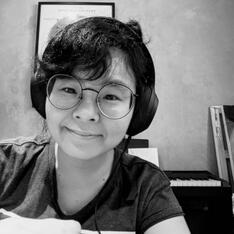
The founder and facilitator
Hi, I am Shin, founder and facilitator at Sounding Piano Studio.I’ve always been someone who questions the way things are usually done — especially when it comes to learning. I care deeply about how people grow, not just what they achieve. Over time, I realised that students learn best when they feel safe to explore, when they’re listened to, and when they don’t have to earn the right to express themselves. That’s why I’ve shaped my teaching around making room for voice, curiosity, and genuine connection to music and not just performance or pressure.Qualifications
Master of Education in (Music)
National Institute of Education (NIE), SingaporeLicentiate of Diploma (LTCL) in Piano Performance
Trinity College of LondonAssociate of Diploma in Music Theory (AmusTCL)
Trinity College of London
If you are parent of a child who wants to learn piano as serious hobby;If you are a teenager who is unsure of what you want to get from piano lessons;If you are an adult who resents of traumatic piano lessons during childhood;If you are simply someone who wants to learn piano and to find out how music works;Or if you simply want to talk to us about piano education and want to collaborate with us,

Email us
Alternatively, you can peep into our snippets of teaching practices and get updated with the latest announcements at our Facebook page and Instagram
Or deep dive into our pedagogy at our blog